| Latest News from INSOL Europe. View this email in your browser. |
|

Summer 2026
|
|
|
Dear INSOL Europe colleagues,
Sometimes it is difficult to think of new things to say in my introductions, and here in the UK although we have yet another new Prime Minister announcing all sorts of ideas, we have become somewhat jaded to announcements made by politicians – at least until we see the action and detail behind them. Cynicism borne of experience. It would be nice to be surprised. My recent introductions have often focused on uncertainty, resilience, geopolitical disruption and the profession's ability to adapt. I was thinking that another adaptation we have had to make is to understand the changing nature of value itself. The profession is increasingly dealing with businesses whose most important assets are data, intellectual property, digital infrastructure, algorithms, customer communities and increasingly AI-enabled products (I have mixed feelings about AI as it either interrupts me when I least want it, or makes stuff up!) It can be useful but I am a bit worried to hear about recent cases of AI committing criminal offences in order to fulfil its instructions.
Still one of the most interesting developments in recent years has been the changing nature of corporate value. Traditionally, insolvency professionals spent much of their time dealing with businesses whose worth could be measured in factories, machinery, stock and property. Increasingly, however, the assets that matter most are intangible as listed above. As artificial intelligence becomes embedded across industries, we may soon add algorithms and proprietary models to that list. This shift presents both opportunities and challenges for our profession, requiring us to think differently about valuation, preservation of assets and recovery strategies. It also brings additional risk considerations.
The wider economic and political environment only reinforces that trend. Across Europe, governments are seeking greater competitiveness and productivity while businesses continue to navigate geopolitical uncertainty, changing trading relationships and evolving regulatory frameworks. At the same time, the recent steps towards greater harmonisation of insolvency laws across the European Union highlight the continuing recognition that efficient restructuring and insolvency systems are essential to economic growth and investment. Our profession sits at the heart of these developments. We are not simply dealing with corporate failure; we are increasingly involved in preserving value, facilitating economic renewal and helping capital, talent and resources find more productive uses. We may be leading failing businesses into the new technologies to cut costs and improve efficiency. We therefore have to be constantly learning. In my specialism in fraud claims, we find that where once we could review metadata to verify the authenticity of documents, now the fraudsters can fake the metadata. So what do we do now? We need to ensure the whole profession is up to date with new technology and new ways of using it both for good and for bad.
What continues to impress me is the willingness of our members to share experience and expertise across jurisdictions. In a period when economies, businesses and technologies are evolving at remarkable speed, that collaboration has never been more important. The issues we face may be changing, but the strengths of the insolvency and restructuring profession remain the same: curiosity, adaptability and a determination to find solutions where others see only problems.
I look forward to seeing you and exchanging more interesting experiences at the Annual Conference in Vilamoura in October. If you haven’t booked yet please do!
Frances Coulson
President, INSOL Europe
|
|
|

Frances Coulson
President of
INSOL Europe
|
This issue is kindly
sponsored by:

DLA Piper is a global law
firm with lawyers located
in more than 40 countries
throughout the world.
www.dlapiper.com
|
|
| IMPORTANT: Delegate List Phishing Emails |
|
We are aware of emails being circulated offering to sell the INSOL Europe Annual Congress 2026 delegate list. These emails are a scam. INSOL Europe does not sell its delegate lists to third parties. These emails are not authorised by INSOL Europe, and the information being offered has not been provided by us.
If you receive such an email, please do not respond, click any links, or provide personal or payment information. Please mark the email as spam/junk and delete it. If you are unsure whether a communication is genuine, please contact INSOL Europe directly through our Contact Us page.
|
|
| Welcome to our latest new members! |
|

|
|
We’re delighted to welcome the newest members of INSOL Europe. Our membership continues to grow across the restructuring and insolvency community, and we’re pleased to introduce the professionals who have joined us over the past month or so.
Diederik Bruloot (Belgium), Catharina Janssens (Belgium), Juraj Blazicko (Croatia), Jesper Saugmandsgaard Øe (Denmark), Caroline Texier (France), Eoghan Corcoran (Ireland), Elena Kouvanidi (Malta), Magdalena Dec (Poland), Kamil Strus (Poland), João Pedro Pinto-Ferreira (Portugal), Cristina Aldea (Romania), Mihaela Chirica (Romania), Horia Florian Joita (Romania), Melania Marinela Marcu (Romania), Ioana Denisa Udrea (Romania), Cayetana Santaolalla (Spain), Etienne Courbois (The Netherlands), Belle Vulto (The Netherlands), Polina Bitiuk (Ukraine), Olena Volianska (Ukraine), Mark Lawford (United Kingdom), and Benjamin Rutledge (United Kingdom).

If you want to connect with these members, they are only a click away in our Membership Directory, available from the 'find a member' search box at top of every page on our website.
|
|
| Annual Congress 2026, Vilamoura - Keynote Speaker Announced! |
|

|
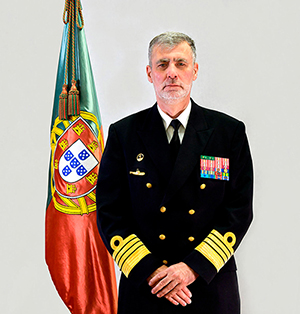
We are delighted to announce that our 45th Annual Congress will open with a keynote address from Admiral Henrique Gouveia e Melo, former Chief of the Portuguese Navy.
Admiral Gouveia e Melo began his naval career in 1979 at the Portuguese Naval Academy, joining the Submarine Squadron in 1985. Over the following years, he served aboard the submarines Albacora, Barracuda and Delfim, later commanding both the Delfim and Barracuda, as well as the frigate NRP Vasco da Gama.
|
 |
|
His career combined operational command with strategic leadership, including postings as Head of the Naval Chief of Staff's Information and Public Relations Office, Director of Lighthouses, and Deputy Naval Commander. From 2017 to 2020, he served as Naval Commander, including two years as Commander of EUROMARFOR.
In 2021, while serving on the General Staff of the Armed Forces, he was appointed to coordinate Portugal's COVID-19 Vaccination Task Force, an effort that gave the country one of the highest vaccination rates in the world, and brought him widespread public recognition. On 27 December 2021, he was promoted to Admiral and took office as Chief of the Naval Staff, a position he held until December 2024.
Admiral Gouveia e Melo has received numerous honours throughout his career, including the Military Order of Avis (Commander grade) and the Naval Order of Merit (Grand Officer) from the Brazilian Navy.
In a keynote address titled "Leading Through Uncertainty: Trust, Resilience and Decision-Making in a Fragmented World," the Admiral will draw on his experience commanding through crisis to speak directly to this year's Congress theme, offering a rare outside perspective on leadership, trust and decision-making under pressure, lessons every restructuring and insolvency professional will recognise from their own work navigating uncertainty.
Technical Programme
Following a record number of submissions this year, we are pleased to share a first draft of the technical programme for the 45th Annual Congress.
We look forward to sharing the full programme shortly, but wanted our members to be among the first to see what's in store.

10 CPD Points Available!
Thanks to our Congress Main Sponsor

|
|
|
| INSOL Europe Academic Forum Conference - 2 months to go! |
|

|
|
View the Updated Technical Programme
The Academic Forum of INSOL Europe will be hosting its 22nd annual conference in Vilamoura, Portugal, on Wednesday 14–Thursday 15 October 2026, immediately prior to INSOL Europe's main Annual Congress taking place in Vilamoura from 15–18 October 2026, which is now only 2 months away!
Vilamoura is a fitting location for this year's conference, held under the theme “New Horizons: Insolvency III, Winding-Up of Insolvent EU Inc. and Beyond.” Set on the Atlantic coast of the Algarve, Vilamoura sits at Europe's south-western edge, looking out toward open water — an apt backdrop for a forum dedicated to charting the next generation of EU insolvency law, from the recently adopted directive “Insolvency III” to the proposed EU Inc. The setting invites participants to look beyond established frameworks and consider the horizons still ahead for European insolvency and restructuring law.
The conference will be hosted at the Tivoli Marina Vilamoura Algarve Resort, situated directly on the beach and adjacent to Vilamoura Marina. The venue offers modern conference facilities alongside a wide range of amenities, and its marina-front setting provides a relaxed, convivial environment for the networking and informal exchange that are a hallmark of the Academic Forum. Vilamoura’s international airport connections via nearby Faro make the location easily accessible for delegates travelling from across Europe and beyond.
Portugal’s position at the western gateway to Europe, combined with its own recent history of insolvency law reform, offers a stimulating vantage point from which to examine the EU’s evolving insolvency architecture. As such, Vilamoura provides not just a picturesque setting, but a thematically resonant one for a conference looking toward the future shape of European insolvency law.
We look forward to seeing you in Vilamoura for the most important academic event of the year!
Academic Forum Chair: Jessica Schmidt
Universität Bayreuth, Germany & Chair of the INSOL Europe Academic Forum
Academic Conference Local Chair: Catarina Serra
Supremo Tribunal de Justiça, Portugal
The Academic Forum is pleased to acknowledge the generous sponsorship
of Edwin Coe LLP and their ongoing support of our activities

|
|
|
Membership Benefits: Make sure you aren't missing out!
- Log into our website to access your Profile: To gain full access to your profile and the members' area of the website, you’ll need to log in with your password. If you haven’t done this yet or have forgotten your password, you can click here.
- Boost your visibility: Make sure your profile stands out and is easy to find. Add a photo, select your ‘areas of work’ and add your LinkedIn page or bio.
- Keep your details up to date: Add a PA contact, an accounts email address and tick the working groups you are interested in.
- Use our Membership Directory to connect with professionals from over 50 countries: Our directory lets you search by name, company, country, profession, or area of work, and once you find the right contact, you are only a click away from connecting with them. Plus, we have now also added a rosette to show how long you have been a member!
- Don't miss out on CPD/CPE Points: Check with your professional body whether attendance at INSOL Europe events qualifies for CPD/CPE credits. If so, please let us know the requirements. Our Annual Congress technical programme is worth 10 hours of training (excluding breaks)!
- Don't miss our Newsletters & Announcements: Consent to receive our emails so you don't miss out on Eurofenix, our newsletters, updates on events, speaking opportunities, calls for articles, and many other opportunities!
- Get further information and tips: Visit our website, welcome page and FAQ section for more info, or email Natasha Sable to give you any further advice.
|
| Focus on: Insolvency Tech & Digital Assets Wing of INSOL Europe |
|

|
|
Technology is no longer sitting at the edge of insolvency practice – it is moving steadily towards its core. Artificial intelligence, digital assets and new legaltech tools are already changing how practitioners work, while evolving regulatory frameworks create new challenges across jurisdictions.
Established in 2019, the Insolvency Tech & Digital Assets Wing (ITDA Wing) provides a forum for INSOL Europe members to explore these developments together, whether they are already active in legaltech or simply curious about how technology may affect their work.
The Wing is now being relaunched with a more practical and structured focus, including dedicated working groups and new projects. These include a global benchmarking project exploring how technology is being used by insolvency practitioners, stronger links with academia, increased contributions to Eurofenix, and further development of the Worldwide Digital Assets Case Register. The Wing aims to connect insolvency professionals with the wider technology ecosystem, share practical experience and build a network where members can learn, contribute and help shape the profession’s response to technological change.
Interested in getting involved?
The ITDA Wing is open to all INSOL Europe members. You can show your interest by updating your membership profile, under ‘About You’, and selecting 'ITDA'.
Members can join the Wing, contribute to existing projects, suggest new initiatives or simply share their experience and knowledge. The next chapter is now being written – and there is an opportunity for everyone to contribute.
For further information, please visit the ITDA Wing web-page here.
|
|
| Richard Turton Award 2026, Winner Announced |
|
The Richard Turton Award Panel is delighted to announce Jeniffer Gomes da Silva as the winner for the Richard Turton Award 2026.
Jeniffer is a Partner at Galdino Advogados, one of Brazil’s leading insolvency and restructuring law firms, where she serves as Deputy Coordinator of the firm's Advisory Team, focusing on judicial and extrajudicial reorganisations, bankruptcy, and business litigation. She is also actively involved in arbitration and previously led the firm's Diversity and Inclusion Committee.
As part of the award programme, Jeniffer will be writing a paper entitled "Beyond Investment: The Functional Role of Investment Funds in Corporate Reorganization".
|

|
|
Jeniffer's paper will explore the growing use of investment funds as restructuring tools within judicial reorganisation proceedings, examining how they are being used to facilitate corporate rescue strategies, manage creditor claims, and support innovative restructuring solutions. Her paper will be published in Eurofenix, and she is also invited to attend the INSOL Europe Annual Congress in Vilamoura, Portugal from 15-18 October 2026.
This year's award attracted a record number of applications - 77 submissions from 16 countries, making the selection process especially competitive. The exceptional quality of submissions made it a challenging decision for the award panel.
The full details of the Richard Turton Award and papers of previous winners can be found here.

|
|
| Eurostat Report: Business registrations down, bankruptcies up in Q2 |
|
|
|
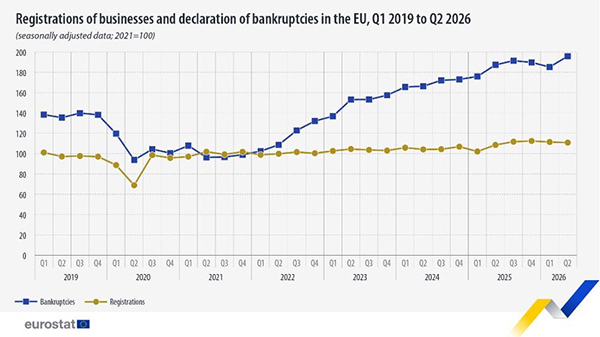
In the second quarter of 2026, registrations of businesses in the EU decreased by 0.5% compared with the first quarter of 2026, while bankruptcies increased by 5.7%.
This information comes from data on business registrations and bankruptcies published by Eurostat on 17 August. This article presents a handful of findings from the more detailed Statistics Explained article on quarterly registrations of new businesses and declarations of bankruptcies.
Registrations down by 3.6% in industry
In the second quarter of 2026, business registrations decreased in 5 out of 8 sectors of the business economy. Industry registered the largest drop (-3.6%), followed by accommodation and food services (-3.4%) and education and social services (-3.2%). The number of business registrations increased sharply in the information and communication sector (+8.8%) and an increase was also recorded in construction sector (+1.0%), while financial services remained stable (+0.0%).
Bankruptcies up by 21.1% in education and social activities
Bankruptcies increased in 5 out of 8 sectors. The largest increases were recorded in education and social activities (+21.1%), transport (+11.4%) and financial services (+6.8%). Decreases in bankruptcies were recorded in the accommodation and food services (-2.6%), construction (-1.7%) and trade (-1.2%).
Source dataset: sts_rb_q
|
|
| National Insolvency Statistics Update - Norway |
|
Corporate insolvencies in Norway fluctuated between 2023 and 2025, with a clear rise in 2024 before conditions eased again in 2025, write Stine Dalenhag Snertingdalen, Partner, Kvale Advokatfirma and Bjørn Løtveit, Partner, Kvale Advokatfirma.
The increase was driven by industries facing higher costs and market uncertainty, while the subsequent decline reflected broad‑based improvements across major sectors, including construction and retail.
|
|
|
At the same time, the use of reconstruction proceedings continued to evolve, with rising case numbers through 2024 and a noticeable drop in 2025, highlighting both the potential and the limitations of the restructuring framework introduced during the pandemic.
The development of corporate bankruptcies in Norway from 2023 to 2025 shows a pattern of moderate fluctuations, with a noticeable rise in 2024 followed by a broad‑based decline in 2025. In 2023, the number of corporate bankruptcies was 3,745, and this increased to 3,917 in 2024, representing a growth of 4.6 percent. Among these, real estate activities stood out with a 52 percent increase, moving from 127 to 193 bankruptcies, while professional, scientific, and technical services also saw a significant rise of 24 percent, increasing from 262 to 325. Although bankruptcies in the construction sector fell from 316 to 252, the industry continued to experience a comparatively high level of insolvencies.
In 2025, the overall number of corporate bankruptcies fell from 3,917 to 3,715. This reduction was broadly based across sectors and brought the level somewhat closer to pre‑pandemic norms, though still higher than in 2021. Construction experienced one of the most notable improvements, with corporate bankruptcies dropping from 1,325 in 2024 to 1,104 in 2025. The wholesale and retail trade sector also showed a strong recovery, declining from 829 to 703 bankruptcies, a reduction of more than 15 percent. Transport and storage saw a slight decrease from 279 to 272, while accommodation and food services experienced a modest decline from 430 to 415. Together, these developments illustrate that after the widespread increase across industries in 2024, most sectors moved in a more positive direction during 2025.
Although 2025 still represented a relatively high level of insolvency activity compared with the lowest point after the pandemic, the year marked a shift away from the turbulence seen in the preceding year. On a longer timeline, the annual average for the pre‑pandemic decade from 2010 to 2019 was approximately 4,556 corporate bankruptcies, compared with an average of around 4,074 for the period from 2020 to 2025. This places 2025 below the historical norm but above the post‑pandemic low. The overall picture is one of a temporary increase in bankruptcies in 2024, driven by industries particularly exposed to higher costs and market uncertainty, followed by a gradual normalization in 2025, with construction, retail, and other major sectors contributing to the general improvement.
With respect to reconstruction proceedings, Norway has seen a steady increase in companies seeking reconstruction since the Reconstruction Act was introduced in 2020 in response to the financial challenges brought on by the COVID‑19 pandemic. Ten reconstructions were opened in 2020, followed by 15 in 2021 and 21 in 2022. In 2023 the number decreased slightly to 19, before increasing significantly to 34 in 2024. In 2025, the number declined to 24. As of 2 March 2026, 5 reconstructions had been opened in 2026. A total of 128 reconstructions have been opened since the Act entered into force. Roughly half of all opened proceedings result in a successful reconstruction, whereas the other half end in bankruptcy.
A key reason many reconstructions fail is lack of liquidity or the refusal of major creditors to support the proposal. Reconstruction proceedings are demanding and costly, requiring companies to have a clear understanding of and control over their financial situation. During the process, operations must be financed through existing liquidity, shareholder contributions, or special‑purpose loans. The companies must also cover the costs of the reconstruction itself. Many companies still seek reconstruction too late or without the financial foundation needed to complete the process.
Although the total number of reconstructions remains relatively modest, the legislation has an impact beyond the cases that result in a confirmed plan. The framework has a guiding effect on negotiations and acts as a meaningful source of pressure and incentive for creditors, encouraging them to engage constructively in financial restructuring efforts.
Sources: Statistics Norway, The Brønnøysund Register Centre
|
|
| Forthcoming Events |
|

|
|
ABI and INSOL Europe International European Insolvency Symposium
Join ABI and INSOL Europe from 2-4 November for the International European Insolvency Symposium, taking place at The Four Seasons Hotel at Park Lane in London. Enjoy three days of expert-led sessions on navigating multinational cases, emerging global trends and the future of international insolvency, plus unmatched networking with leaders in the field.
For full details and to register, visit the ABI website here.
A joint organising committee from ABI and INSOL Europe is working on the technical programme, and further information will be announced soon.
|
|
|
|
Thanks to our General Sponsors
Please contact Hannah Denney for sponsorship opportunities.
We welcome feedback, news and story ideas for future newsletters.
Please send your suggestions to Paul Newson, email: paulnewson@insol-europe.org
Follow us on LinkedIn and join the conversation!
|
| INSOL Europe, PO Box 7149, Clifton, Nottingham. NG11 6WD |
| www.insol-europe.org |
| Unsubscribe from INSOL-Europe.org mailing. |
| Disclaimer: This newsletter is sent to members of INSOL Europe. No responsibility legal or otherwise is accepted by INSOL Europe for any errors, omissions or otherwise. The opinions expressed in the articles that appear are not necessarily shared by any representative of INSOL Europe. |
|
|
.jpg)