| INSOL Europe April Newsletter. View this email in your browser. |
|

April-May 2025
|
|
|
Dear Members
Last week the very successful EECC conference took place in Bucharest. It was very special to attend and to gain so many insights. The Romanian Minister for Economy, Digitalization, Entrepreneurship and Tourism, Dr Bogdan Ivan was the first keynote speaker and he illustrated very well that staying on the European track would give Romania the best opportunity to face the challenging times. The second keynote speaker, Mr Cristian Popa, Member of the Board of the Romanian National Bank, showed us, with very insightful slides, the economic effects of political decisions over the past 20 years for Romania and for the other EU countries. The two presentations set the scene for a wonderful conference. I thank the Technical Committee, with the Technical Committee Co-chairs, Stela Ivanova and Georges-Louis Harang, for all their preparatory work! There was also an excellent turnout, with 15 jurisdictions present.
With the EECC conference behind us, our focus is now on the Vienna congress. The congress has launched; we are finalizing the program at the moment. I think the Technical Committee with the Technical Co-chairs Christel Dumont and Matthias Prior has been able to grasp the most important subjects that will interest all of you, so I encourage you to take advantage of the early booking possibilities.
During our EECC conference a lot of participants confirmed that these are busy times for our professionals, some countries more restructurings, some more insolvencies. In Germany insolvency numbers are the highest since the financial crisis and the German economy is not the engine of the EU economy it has been in the past. Other challenges come our way, whether it is tariffs or geopolitical issues. All these issues will have an impact on the economies and businesses in the EU. They will also impact us. I hope that the preventive restructuring systems will help businesses survive. If they don’t, then the Recast European Insolvency Regulation, that is celebrating its 10th birthday this year, can help when there is a cross-border impact. Let’s hope out toolkits are adequately stocked so companies worth saving survive the consequences of the harsher economic climate.
Kind regards,
Alice van der Schee
President, INSOL Europe
|
|
|

Alice van der Schee
President of
INSOL Europe
|
This issue is kindly
sponsored by:

DLA Piper is a global law
firm with lawyers located
in more than 40 countries
throughout the world.
www.dlapiper.com
|
|
| Annual Congress 2025 - Vienna, Austria - Registration now open! |
|

|
|
We are pleased to announce that registration is now open
for the INSOL Europe Annual Congress in Vienna!
The programme is currently being developed by the
Technical Committee and details will be announched soon.
Find out more here | Register here
Watch the film here!

|
|
With thanks to our Main Sponsor:

|
|
| EECC Conference 2025 - Bucharest, Romania |
|

|
|
Thank you to all our members who attended the recent conference in Bucharest, which was finally attended by over 100 delegates.
A report and photos of the event will be published soon... watch this space!
With thanks to our Main Sponsor

Conference Sponsors
|
|
| Eurofenix Spring Edition 2025 Now Published |
|
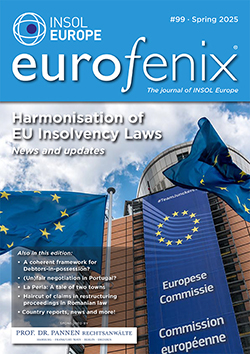
The Spring 2025 edition of Eurofenix is now available to view online, featuring reports, case studies, European law updates and conference news, as well as many other articles including:
- Harmonisation of EU Insolvency Laws - News and updates
- A coherent framework for Debtors-in-possession?
- (Un)fair negotiation in Portugal?
- La Perla: A tale of two towns
- Haircut of claims in restructuring proceedings in Romanian law
- Country reports, news and more!
If you would like to contribute an article to a future edition or are interested in advertising opportunities, please contact publication manager Paul Newson.
Eurofenix is kindly sponsored by Prof.Dr.Pannen

|
Read the new edition here!
|
|
| INSIDE Story: Grey Areas in the Failure of Crypto Firms |
|
Cryptoassets have grown in popularity in recent years, with 8% of EU citizens reported as having crypto investments. This is also an area of unusually high cross border investment in the EU, with 40% of crypto investments crossing borders.
There has been similar or greater interest in many other countries, including in developing countries, often without awareness of the real risk entailed.
|

|
|
When failures happen, they have the potential to be cross-border and legally messy and studies have highlighted that crypto businesses may not address insolvency issues adequately in terms of service or otherwise.
The INSIDE Story (also published in the Spring edition of Eurofenix) by Rebecca Parry, Professor, Nottingham Law School distinguishes between different types of cryptoassets and service providers, noting that many operate without clear legal terms or sufficient consumer protections, and often in jurisdictions with light regulation. Failures such as FTX and Terra/Luna highlight the unpredictability of where and how insolvencies are handled, which can impact creditor rights and prolong case resolution. The research emphasizes the need for more predictable legal approaches, better industry practices, and possibly market-driven solutions to fill regulatory gaps, particularly in countries lacking robust legal protections for crypto investors.
Read the full story and others on our website here.
|
|
| National Statistics Update - Hungary |
|
By the end of 2024, the number of operating companies had fallen by 11,000. More than 35,000 business entities dissolved last year, while the number of new firms established exceeded 14,000. The number of new liquidation proceedings remained above 15,000, with 4,000 companies in the construction business and 4,300 in the commercial sector. Despite implementing the Restructuring Directive, however, there has been no reported restructuring case. Petra Springer from DLA Piper has summarized recent statistics in Hungary.
|
 |
|
The company trends for 2024 indicate that the economic environment continued to present significant challenges for Hungarian companies: GDP growth remained below 1%, impacted by a shortfall in EU funds, weak government and business investment, and a high interest rate environment compared to recent years. Economic operators have been weighed down by the volatility of the Hungarian forint, the weak economic performance of its main export partner Germany, and the downturn in the automotive and battery sectors.
According to the data of OPTEN, the number of active enterprises has fallen again, while economic uncertainty has discouraged business start-ups. In 2024, 505,000 companies were active, a 2.2% decrease compared to the previous year, when the number of active enterprises also fell by more than 12,000.
The decline in the number of firms particularly affected manufacturing (2.8% decline, with more than 1,000 firms) and construction sectors (3% decline, with nearly 2,000 firms), while trade and repair of motor vehicles saw a loss of more than 3,000 firms (2.9% decline). Administrative services and education also shrank, with both sectors down 2.8%.
The number of start-ups continued to decline, with more than 24,000 new businesses created in 2024, a drop of almost 10% compared to 2023. At the same time, the number of businesses dissolving remained high, with more than 35,000 closed businesses, a slight decrease compared to more than 37,000 in 2023.
Of particular concern is that the number of firms dissolved through liquidation proceedings (felszámolás) approached 18,000, reflecting the increasing insolvency trend. The number of new liquidation proceedings remained significant at over 15 thousand, a national rate of 3%. Although this is a slight decrease compared to 4% in 2023, the economic burden is still dominant. Construction and trade are the sectors most affected, with 4,000 and 4,300 businesses at risk of being lost in the future. Pressure is also being felt in manufacturing, with nearly a thousand firms going into liquidation. The number of new liquidation proceedings remained significant at over 15,000, a national rate of 3%. Although this is a slight decrease compared to 4% in 2023, the economic burden is still dominant. Construction and trade are the sectors most affected, with 4,000 and 4,300 businesses at risk of being lost in the future. Pressure is also being felt in manufacturing, with nearly a thousand firms going into liquidation.
On a positive note, the number of forced deregistration proceedings (kényszertörlés) has fallen significantly to below 6,000, compared to 8,000 in 2023. This may indicate a partial stabilisation of the business environment or an improvement in the efficiency of the administrative procedures. On the other hand, the number of firms terminated by voluntary winding-up proceedings (végelszámolás) has fallen sharply, from nearly 19,000 companies opting for a voluntary winding-up in 2023 to around 10,000 in 2024.
New forced deregistration proceedings have risen slightly, which suggests an increase in the number of liquidations in the future. By contrast, new liquidations have fallen sharply, indicating that it is becoming increasingly difficult to dissolve a company in a conscious and stable manner.
Hungary implemented the Preventive Restructuring Directive (EU) 2019/1023 by introducing Act LXIV of 2021. The purpose of the restructuring proceedings (szerkezetátalakítási eljárás) was to enable debtors to restructure effectively at an early stage and to adopt and implement a restructuring plan with creditors in order to avoid insolvency and ensure viability. Since its entry into force on 1 July 2022, however, there have been no reported cases, which may also be attributable to the fact that the proceedings may be conducted non-publicly, as well.
Read further updates from Hungary and other jurisdictions on our website here.
|
|
|
10 Reasons to renew your Membership in 2025
- Get DISCOUNTED RATES for our flagship Annual Congress, Academic Conference, Eastern European Conference and joint events.
- Become part of our unique and RENOWNED COMMUNITY where you will have opportunities to network with over 1300 members from 50 countries.
- Access our MEMBERSHIP DIRECTORY where you can search for fellow members by name, jurisdiction, profession and expertise.
- Get in touch with your Council member and Country Co-ordinators to MAKE CONNECTIONS within your own country.
- Automatically become a member of INSOL International and get their full member benefits.
- Enjoy a free subscription to EUROFENIX, INSOL Europe’s popular quarterly 48-page journal.
- Free access to our huge TECHNICAL RESOURCES library.
- Opportunity to PUBLISH ARTICLES in Eurofenix, our Monthly newsletter, on our website and social media.
- GET INVOLVED on projects that affect your particular industry in one of our many working groups or committees.
- INSOL Europe has a STRONG RELATIONSHIP with EU officials and representatives of inter-governmental organisations.
|
Visit our website for more details or contact Hannah Denney.
|
| Richard Turton Award 2025: Win a free place to the Vienna Congress! |
|

|
|
Richard Turton had a unique role in the formation and management of INSOL Europe,
INSOL International, the IPA (English Insolvency Practitioners Association) and R3 (Association of Business Recovery Professionals in the UK). In recognition of his achievements, these four organisations jointly created an award in memory of Richard.

The 2025 competition is now open for anyone who is a national of a developing or emerging nation; works in or studies insolvency & restructuring law and practice and is under 35 years of age.“In addition to granting me access to the INSOL Europe community, winning The Richard Turton Award serves as a springboard to my career in global restructuring and insolvency oractice.” Emily Onyango, 2024 Winner
The successful applicant will be asked to write a paper of 3,000 words on a subject of insolvency or turnaround agreed with the panel. This paper will be published in summary in one or more of the four Member Associations' journals and in full on their websites. The winner will be invited to attend the INSOL Europe Annual Congress in Vienna, Austria, 9-11 October, expenses paid. Applications deadline: 6 June 2025.
For more information and to apply, visit the Richard Turton Award page here.
|
|
| Annual R3 & INSOL Europe Conference returns to London in July |
|

|
|
|
This conference is aimed at all restructuring and insolvency professionals with an interest in cross-border matters, not only at UK and other European lawyers and insolvency practitioners, but at all professionals interested in cross-border restructuring and insolvency, including financial advisers, lenders, distressed asset investors, judges and academics. 5 CPD points. Find out more and Book your place now!
|
|
| Forthcoming Events in 2025 - Save the Dates! |
|
We are already working on our next series of high-profile events, presenting many opportunities for businesses, industries, and professionals to connect, innovate, and grow. The year will offer numerous occasions for networking, thought leadership, and market expansion. Here’s a preview of the key INSOL Europe events that will drive business opportunities and shape trends in 2025.
- 12-14 June 2025, AIJA/INSOL Europe Young Members Group (YMG) Joint Conference, Girona, Spain
- 3 July 2025, Joint Conference with R3
- 7-8 October 2025, Academic Forum Conference, Vienna, Austria
- 9-12 October 2025, Annual Congress, Vienna, Austria
|
 |
|
Visit our website for more events to be added as they are confirmed.
|
|
|
|
Thanks to our General Sponsors
Please contact Hannah Denney for sponsorship opportunities.
We welcome feedback, news and story ideas for future newsletters.
Please send your suggestions to Paul Newson, email: paulnewson@insol-europe.org
Follow us on LinkedIn and join the conversation!
|
| INSOL Europe, PO Box 7149, Clifton, Nottingham. NG11 6WD |
| www.insol-europe.org |
| Unsubscribe from INSOL-Europe.org mailing. |
| Disclaimer: This newsletter is sent to members of INSOL Europe. No responsibility legal or otherwise is accepted by INSOL Europe for any errors, omissions or otherwise. The opinions expressed in the articles that appear are not necessarily shared by any representative of INSOL Europe. |
|
|





.jpg)