| INSOL Europe Newsletter August 2025. View this email in your browser. |
|

September 2025
|
|
|
Dear Members
Only 9 days to our Annual Congress in Vienna. I can’t wait to see you all!
I am very happy to announce that we’ll have a record-breaking attendance of more than 480 participants for the main Congress joining us in beautiful Vienna, plus 80 for the Academic Conference. We’ve been very busy during the last few weeks, not only with preparations for the Congress but aIso with the council elections. We had a good turnout of voters, and we’ll start the upcoming council meeting with a lot of fresh faces. Also, we’ve been busy with the Strategic Taskforce and the strategic plan. I’ll be telling you more about that during the beginning of the Congress and it will be focused on membership engagement. I expect that there will be more from INSOL Europe in store for you. Finally we’ve been putting the finishing touches on the Technical Programme for the Congress, and I am happy to tell you that it is complete. So many interesting panels on so many different topics, Matthias Prior and Christel Dumont, our Technical Co-chairs for Vienna, have done an excellent job putting the Technical Programme together.
This newsletter comprises i.a. updates on a ground-breaking judgement by the Ukrainian Supreme Court, resolving a bankruptcy proceeding with assets in the occupied territories, and insolvency statistics in Cyprus. As the trilog has started at the EU, I expect a lot of news on the completion of the EU directive on harmonization of certain aspects of insolvency law. After our Annual Congress in Vienna, we will be collaborating with the American Bankruptcy Institute for a two-day conference in Berlin on 27-28 October 2025. Plus, on 28 of November 2025 Reseau Cap and INSOL Europe will host a one-day conference in Brussels where the panels will be focused on several aspects concerning group restructurings and group insolvencies. More information about these events will follow soon.
I hope to be able to catch up soon and see you in Vienna!
Alice van der Schee
President, INSOL Europe
|
|
|

Alice van der Schee
President of
INSOL Europe
|
This issue is kindly
sponsored by:

DLA Piper is a global law
firm with lawyers located
in more than 40 countries
throughout the world.
www.dlapiper.com
|
|
| Vienna 2025 Annual Congress & Academic Conference: Next week! |
|
|
| Uktrainian Court rules in case where the Debtor's property is located in a temporarily occupied territory |
|
The Court of Cassation (Commercial Division) has adopted a legal position in case No. 913/355/21, which is significant in the context of a liquidation procedure involving a debtor whose property is located in a temporarily occupied territory of Ukraine during martial law, writes Vadym Kizlenko, Counsel, Co-Head of Insolvency and Financial Restructuring, Attorney at Law, Insolvency Receiver, Ilyashev & Partners Law Firm.
|

|
|
In this case, the liquidator filed a motion to close the bankruptcy proceedings due to the impossibility of completing the liquidation procedure. The liquidator argued that the debtor’s only property complex is situated in a temporarily occupied territory, to which there is no access, thus the assets cannot be sold. Other property of the debtor is also unavailable.
The court of first instance and the court of appeal rejected the motion, referring to the absence of an exhaustive list of grounds for terminating bankruptcy proceedings.
However, the Court of Cassation took a different view. Its key argument was based on Article 90(1) of the Code of Bankruptcy Procedures, which allows for the termination of proceedings where other circumstances arise that make further consideration of the case impossible.
According to the Court of Cassation, the lack of access to the debtor’s property located in the occupied territory may constitute such a circumstance.
The Court of Cassation further emphasised the need to determine whether the liquidator had taken all reasonable steps to identify, access, or replace the property – including efforts to locate other assets, assess the possibility of selling part of the property, or restore access to the affected assets.
The Court’s conclusion also reflected current legislative restrictions on enforcement and other procedural actions concerning property located in temporarily occupied territories or combat zones. This means that further continuation of bankruptcy proceedings would not only be meaningless in legal terms but would also conflict with the principle of procedural economy.
Under the exceptional conditions of wartime, courts may recognise the impossibility of completing a liquidation procedure as sufficient grounds for closing a bankruptcy case.
The legal position expressed by the Court of Cassation underscores the judiciary’s role in addressing legislative gaps and adapting the application of the Code of Bankruptcy Procedures to the realities of martial law.
|
|
| AI - Critical tool in preventing insolvency with data driven management |
|
Artificial intelligence is becoming a critical tool in preventing insolvency by enabling data-driven management. Through big data analytics and machine learning, AI can process vast amounts of financial and market information to identify early warning signs of insolvency more accurately than traditional methods. This allows directors to make proactive, informed decisions that can safeguard the long-term stability of companies. However, the benefits of AI come with challenges, including questions of transparency, accessibility for smaller businesses, and compliance with legal and ethical standards. While AI can enhance risk management, its integration requires careful consideration of these broader implications.
|

|
|
The legal responsibility of directors using AI for insolvency prevention raises complex issues. Portuguese law imposes duties of care and loyalty on directors, but current liability frameworks - focused on fault - are inadequate when decisions are influenced by AI systems. Directors may be held liable both for choosing to use AI and for the outcomes of AI-assisted decisions, despite the fact that AI itself carries no liability. The business judgment rule offers some protection if AI is used rationally, but differing interpretations could either shield directors or increase their exposure. Existing liability models, such as product liability or joint liability, do not easily extend to AI use, highlighting the need for legislative reform to address gaps in accountability.
As a transitional solution, Directors & Officers (D&O) insurance can help mitigate risks until a more robust legal framework is established. In Portugal, where many companies are small and family-owned, liability claims are relatively rare, but the integration of AI in management decisions increases potential exposure. Insurance offers directors protection under the precautionary principle, ensuring they are not deterred from using AI in fear of liability. In the longer term, legislative intervention will be essential to clearly define the liability of AI operators or to mandate compulsory insurance schemes. Ultimately, AI holds significant promise for insolvency prevention, but its responsible use depends on balancing technological innovation with legal and ethical safeguards.
This topic is discussed in the latest edition of Eurofenix by Francisco da Cunha Matos
(Senior Associate, PLMJ Dispute Resolution Team) - Read it here.
The Autumn edition is due to be launched next week, and then we will be looking for articles for the Winter edition. Please do get in touch with Paul Newson with your ideas for contributions.
|
|
| Strengthening our network with National Associations |
|
Working with our Country Coordinators, we are continuing with our programme to develop a close relationship with the relevant National Association (or similar body) in each jurisdiction covered by our members. With these agreements, we hope to increase the flow of information between the bodies, and work together on future events (such as a recent seminar with CEDI and a planned event with Reseau Cap in Brussels).
We are very happy to report that we now have a total of 14 agreements, with more in the pipeline.
|

|
|
A full list is shown below and on our website here.
|
|
|
10 Reasons to renew your Membership in 2025
- Get DISCOUNTED RATES for our flagship Annual Congress, Academic Conference, Eastern European Conference and joint events.
- Become part of our unique and RENOWNED COMMUNITY where you will have opportunities to network with over 1300 members from 50 countries.
- Access our MEMBERSHIP DIRECTORY where you can search for fellow members by name, jurisdiction, profession and expertise.
- Get in touch with your Council member and Country Co-ordinators to MAKE CONNECTIONS within your own country.
- Automatically become a member of INSOL International and get their full member benefits.
- Enjoy a free subscription to EUROFENIX, INSOL Europe’s popular quarterly 48-page journal.
- Free access to our huge TECHNICAL RESOURCES library.
- Opportunity to PUBLISH ARTICLES in Eurofenix, our Monthly newsletter, on our website and social media.
- GET INVOLVED on projects that affect your particular industry in one of our many working groups or committees.
- INSOL Europe has a STRONG RELATIONSHIP with EU officials and representatives of inter-governmental organisations.
|
Visit our website for more details or contact Hannah Denney.
|
| INSIDE Story: New Comprehensive Protection in Bulgaria for Close-out Netting Arrangements in Insolvency |
|
A comprehensive Bulgarian close-out netting law was promulgated on 15 August 2025. It is structured as an amendment and supplement to the Financial Collateral Arrangements Act (the “Amendment”), which transposed the EU Financial Collateral Directive 2002/47/EC (the “FCD”) in Bulgaria. To reflect its broader scope, the title of the act was also changed to the “Financial Collateral and Close-out Netting Arrangements Act” (the “Act”).
|

|
|
The structural approach of the Amendment introduces a new close-out netting regime, building on the well-established financial collateral concepts that have been applied and court-tested in Bulgaria for over 18 years. Furthermore, to define the scope of the new regime, the Amendment refers to the terminology according to the domestic transposition of the EU MiFID Directive 2014/65/EU (the “MiFID”), while the new general conflict-of-law netting rule follows the wording under Article 25 of the EU Winding-up Directive 2001/24/EC (the “WUD”) as transposed in Bulgaria. Such reliance on established concepts will hopefully facilitate the practical application of the Amendment.
Read the whole story here by Tsvetan Krumov (Partner, Schoenherr, Bulgaria; Senior Assistant Professor in Private International Law, Law and State Institute, Bulgarian Academy of Sciences; Co-Chairman, EBRD Working Group on the Bulgarian close-out netting law.)
|
|
| Update on National Insolvency Statistics from Cyprus |
|
Insolvency cases in Cyprus have generally seen a downward trend over the past decade, from their peak in 2016 with a total of 3,286 cases to 1,704 cases in 2024, reports Andri Antoniou, Director, Insolvency Practitioner, CRI Group, Cyprus.
|
 |
|
Corporate Insolvency
There were 1,772 voluntary liquidations during 2022. This number declined to 1,602 in 2023, and further to 1,510 in 2024. Based on these figures, cumulatively, there has been a 15% decline over the two-year period.
Whilst the number of compulsory liquidations has generally fallen over the past decade in 2023, 102 winding up orders were issued, resulting in a 79% increase in compulsory winding up orders, compared to 2022. In 2024, the number of compulsory liquidations decreased again, to 42.
Examinership was introduced in Cyprus in 2015 to provide a formal restructuring tool offering companies in financial difficulty a pathway to survival as a going concern. Whilst there has been a total of 23 Examinership applications since its introduction, none have resulted in the successful appointment of an examiner.
Personal Insolvency
The number of bankruptcy orders have fallen over the past decade, from 80 in 2015 to just 35 in 2024.
Personal Repayment Plans (PRP) were introduced in 2015, allowing debtors to restructure their debts. The main objective of the PRP is for the debtor to maintain their primary residence, where possible, and ensure the repayment of creditors over an agreed period. There has generally been an upward trend in PRP applications since their introduction, from 3 applications in 2025 to 199 in 2023, although there was a significant reduction in 2024 to 106 applications.
It is positive that applications for PRPs are proving to have some success, giving debtors the opportunity to avoid bankruptcy through a formal restructuring tool, however, it is unfortunate that Examinership has not shared this success and remains to be seen if legislative amendments will be made with a view to Examinership becoming a useful restructuring tool or whether it will be abolished and replaced altogether.
Read further updates from Cyprus and other jurisdictions on our website here.
|
|
| Forthcoming Events |
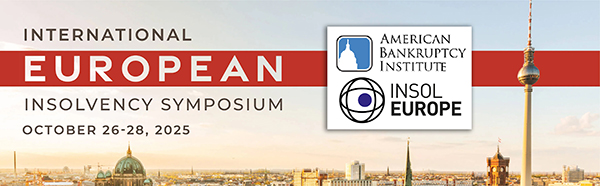
ABI and INSOL Europe are pleased to welcome you to the 2025 International European Insolvency Symposium, taking place this fall at The Ritz-Carlton, Berlin — a landmark of elegance in the heart of Germany’s dynamic capital. Join colleagues from around the globe for two days of premier programming focused on the latest international insolvency and restructuring developments.
INSOL Europe speakers include former Presidents, Barry Cahir (Ireland) and Frank Tschentscher (Germany).
For further information and to register your place, visit the ABI website.
|
|
|
Thanks to our General Sponsors
Please contact Hannah Denney for sponsorship opportunities.
We welcome feedback, news and story ideas for future newsletters.
Please send your suggestions to Paul Newson, email: paulnewson@insol-europe.org
Follow us on LinkedIn and join the conversation!
|
| INSOL Europe, PO Box 7149, Clifton, Nottingham. NG11 6WD |
| www.insol-europe.org |
| Unsubscribe from INSOL-Europe.org mailing. |
| Disclaimer: This newsletter is sent to members of INSOL Europe. No responsibility legal or otherwise is accepted by INSOL Europe for any errors, omissions or otherwise. The opinions expressed in the articles that appear are not necessarily shared by any representative of INSOL Europe. |
|
|

.jpg)


.jpg)