| Latest News from INSOL Europe. View this email in your browser. |
|

March 2026
|
|
|
Greetings Friends and Colleagues!
I cannot believe I am halfway through my presidency. As we move through March, it is already proving to be another eventful month for Europe, both for our profession and for the wider geopolitical landscape. The cross‑currents between economic fragility, restructuring pressures and international instability continue to shape the environment in which all our members are operating.
Across Europe, insolvency developments have been especially stark. Corporate insolvencies in Germany have now risen to their highest level since 2014, with 24,064 filings representing a 10.3% increase year‑on‑year. In the UK, the market has also seen turbulence: the recent administration of Century Capital* – triggered after discrepancies emerged at director level – highlights once again how governance failures and credit stress continue to interplay in our sector. Meanwhile, courts across the region are grappling with increasingly complex cross‑border issues, from Irish recognition of Northern Irish voluntary arrangements to far‑reaching debates around the scope of the European Insolvency Regulation in bank‑related appeals.
EU‑wide legal frameworks are also shifting. The European Parliament has formally approved the long‑awaited Directive harmonising certain aspects of insolvency law, a significant milestone in efforts toward coherence and predictability across Member States – developments that will be of great interest to all restructuring professionals. It seems to have been a long wait, but it will be more interesting now to see the differences in implementation across the EU and the practical use of the tools the Directive promotes.
These technical changes are unfolding against a backdrop of heightened geopolitical tension. EU leaders meeting (as I write) this week in Brussels are confronting a crowded agenda: the stalled €90bn Ukraine support package, a difficult sanctions landscape, energy affordability challenges reminiscent of the 2022 crisis, and the need to strengthen the EU’s defence readiness. Broader global pressures – most notably the escalating conflict involving Iran, the US and Israel – continue to inject volatility into markets, energy pricing and confidence indicators across Europe.
In such uncertain times, our community’s commitment to knowledge‑sharing, cross‑border cooperation and technical excellence becomes ever more vital. INSOL Europe remains deeply engaged in championing harmonisation initiatives, fostering dialogue among practitioners and regulators, and supporting the profession as we navigate both the immediate challenges and the structural shifts shaping 2026.
This month I enjoyed the warm hospitality in Dublin of the RII with our Irish colleagues and other guests from R3 and beyond, and was very pleased and impressed that €7,000 was raised on the evening for "Matilda's Miles" a charity doing wonderful work raising money for Crumlin Hospital for children with heart defects.
The INSOL Europe & Réseau CAP Joint Seminar "Groups of Companies Under Pressure!" held on Friday 6 March 2026 at the Palais des Académies, Brussels, was a great success and attendees enjoyed a tour of the Palais de Justice afterwards. Thanks particularly to Bart de Moor (INSOL Europe Country Coordinator for Belgium), and to Ondřej Vondráček (Representative of the European Commission) and the other speakers, and to my predecessor Alice Van Der Schee for attending as unfortunately I was unable to.
Last week we held our Spring Council meeting in London, where I was delighted to host Council members and the INSOL Europe Team for the meetings at Wedlake Bell's offices overlooking St Paul's, as well as to dinner at a couple of London's lovely clubs and restaurants. During the meetings we had some great discussions which will inform our future strategy. More to come on that soon!
I hope you find this month’s newsletter both insightful and energising. As ever, I look forward to seeing many of you at upcoming meetings and conferences – and to continuing the important work we do together across jurisdictions.
Frances Coulson
President, INSOL Europe
*London-based bridging lender Century Capital Partners entered administration on 30 January 2026, following the discovery of financial discrepancies and the dismissal of a director. Blue Owl Capital, a major creditor with £36m exposure, triggered the insolvency. RSM UK Restructuring Advisory LLP was appointed to manage the administration.
|
|
|

Frances Coulson
President of
INSOL Europe
|
This issue is kindly
sponsored by:

DLA Piper is a global law
firm with lawyers located
in more than 40 countries
throughout the world.
www.dlapiper.com
|
|
| Hot News from the EU! Proposal for a Regulation on the 28th Regime Corporate Legal Framework: EU Inc |
|
On 18 March, the European Commission presented its proposal for EU Inc., a new single set of corporate rules, building the cornerstone and starting point for the EU's 28th regime. EU Inc. is an optional, digital-by-default European corporate framework. It will make it easier for businesses to start, operate and grow across the EU – incentivising them to stay in Europe, and encourage those who once looked elsewhere to return. Report by Emmanuelle Inacio, INSOL Europe Chief Technical Officer
|
 |
|
Main features of EU Inc. include:
- Faster registration: Entrepreneurs, founders, and companies will be able to found an EU Inc. company within 48 hours, for less than €100 and with no minimum share capital requirements.
- Simpler procedures: EU Inc. companies will only need to submit their company information once, via an EU-level interface connecting national business registers together. In a second step, the Commission will establish a new central EU register. EU Inc. companies will obtain their tax identification and VAT numbers without having to resubmit paperwork.
- Fully digital operations: Corporate processes will be digital by default throughout a company's lifecycle.
- Helping founders restart faster and cheaper: EU Inc. companies will have access to fully digital liquidation procedures. Innovative startups will have access to simplified insolvency procedures to facilitate the winding down of operations. This enables founders to try and test innovative ideas and start again if needed.
- Better conditions to attract investment: Today's proposal will remove in-person formalities, provide digital procedures for financing operations, and simplify the transfer of shares. There will be no more mandatory involvement of intermediaries for share transfers, and liquidation procedures. The proposal will also allow Member States to give EU Inc. companies access to the stock exchange.
- Better means to attract talents: EU Inc. companies will be able to set up EU-wide employee stock option plans. The stock option will only be taxed on the income generated once it is sold. This is a crucial factor in ensuring attractiveness, particularly for innovative startups.
- Full access to the Single Market: EU Inc. companies will be free to choose the Member State in which they incorporate. The proposal includes a blacklist of prohibited practices to ensure that EU Inc. companies are treated the same way as any other national companies.
- Strong safeguards against abuse: National employment and social laws are not affected by the proposal. They will apply to EU Inc. the same way they apply to any other business under national company law. The applicable safeguards of the Member State of registration will apply in full to the EU Inc. company, including when it comes to rules regarding co-determination.
- Flexibility of shares: EU Inc. companies will have the flexibility to create different classes of shares with varying economic or voting rights. This can, for example, help founders protect their business against hostile takeovers.
Next steps: The EU Inc. proposal will now be discussed by the European Parliament and the Council. The Commission will do its utmost to support the co-legislators in this respect with the clear objective to reach an agreement by end of 2026. More information here
|
|
| More Hot News from the EU! Directive Harmonising Certain Aspects of Insolvency Laws - Update |
|
On 30 March, the Council gave the final stamp to a new EU Directive harmonising key aspects of insolvency rules across the EU. The law will make the EU business environment more attractive to cross-border investors by reducing the complexity of different national insolvency rules. This is an important step towards more efficient and integrated European capital markets that are crucial to the EU’s competitiveness. Report by Emmanuelle Inacio, INSOL Europe Chief Technical Officer.
|
 |
|
The EU common rules for insolvency proceedings include measures for:
- Avoidance action: challenge transactions made by the debtor before the start of the bankruptcy procedure, thus protecting the insolvency estate against the illegitimate removal of assets.
- Tracing assets: allow authorities, at the request of insolvency practitioners, to search bank account registers across the EU to identify assets of insolvent companies.
- Pre-pack proceedings: enable the sale of a company in financial difficulty to be negotiated before the opening of formal proceedings and executed shortly after, while maintaining contracts which are essential for the continuation of the business.
- Directors’ duties: require directors to file for insolvency within three months of financial distress, helping maximise recovery for creditors while allowing flexibility if alternative measures protect creditors equally.
- Creditors’ committees: strengthen the involvement of individual creditors in the proceedings.
- Transparency: require each country to publish clear factsheets on its insolvency laws, which will be made available on the EU’s e-Justice portal.
Next steps: Member states will have two years and nine months to transpose the directive into national law. More information here
|
|
| YANIL News: 2025 Research Prize Winners Announced |
|
YANIL, a branch of the INSOL Europe Academic Forum (IEAF), provides a lively and supportive network for younger academics to grow their academic talents. In pursuit of its objectives, various initiatives to present and publish research have been developed in recent years.
A new challenge pressing YANIL is to ensure that the research of younger academics enjoys the attention it deserves and is disseminated as widely as possible.
|
|
|
The refreshing ideas of younger academics, thanks to new questions, methods, or solutions proposed, are considered crucial for the development of the academic debate. With this new Prize, YANIL aims to raise awareness of their research and support them in pursuing an academic career.
The 3rd Edition's Jury is very pleased to announce the results of the 3rd edition of the YANIL Research Prize for Innovative and Outstanding Research.
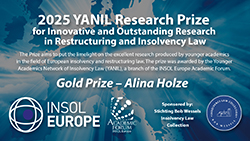
The Gold Prize of the 2025 YANIL Prize goes to Alina Holze for her paper: “The Scope of Protection of the Principle of Sovereign Immunity against Insolvency Challenges in the European Single Market considering Article 6 (1) EU Insolvency Regulation". This paper examines the interaction between tax, insolvency, and public international law. A pending CJEU case focuses on the interpretation of Article 6(1) EIR 2015 and brings these fields into direct relation, providing an opportunity to analyze their interaction.
For details of the jury and the Silver and Bronze Prizes, visit the YANIL website here.
Congratulations to the prize winners, and a sincere thanks to all participants this year for their excellent submissions.
The winners' videos are available on YANIL's YouTube Channel.
|
|
| Update on National Insolvency Statistics: Ukraine |
|
Since the beginning of 2022, the economic situation in Ukraine has remained complicated: significant destruction and damage to civil and industrial infrastructure, disruptions in logistics, increases in the cost of goods and services, and rising tax burdens, among other factors, have negatively affected and continue to affect the financial condition of both individuals and legal entities, writes Oleksander Plotnikov (Partner, attorney-at-law, Arzinger) and INSOL Europe Country Coordinator.
|
 |
|
Nevertheless, Ukrainians show resilience and perseverance, as evidenced, in particular, by statistical data on the number of bankruptcy proceedings opened, published by the Supreme Court of Ukraine.
Data for 2022 indicate that the outbreak of the full-scale Russian invasion did not result in mass bankruptcies among the population. On the contrary, during 2022, 9,725 proceedings in bankruptcy cases were initiated, which is 42% less than during the same period in 2021. Among them 583 new bankruptcy proceedings in relation to legal entities, and 419 new cases related to insolvency of individuals and private entrepreneurs.
However, data for subsequent years show an increase in the number of bankruptcy proceedings, which can be explained by a "delayed demand" effect following the shock of 2022. Specifically, in 2023 - 575 bankruptcy cases concerning individuals were initiated, in 2024 - 926 cases, in the first half of 2025 - 577 cases were opened. Among legal entities, 780 officially commenced bankruptcy proceedings in 2025. It is observed that, year after year, the number of bankruptcy proceedings concerning legal entities remains higher than those concerning individuals and individual entrepreneurs.
The data also evidence that the majority of business-related bankruptcy proceedings are initiated in Kyiv — approximately 20%. Following the capital, the highest incidence of business-related bankruptcy proceedings is observed in the frontline territories — Zaporizhzhia, Dnipropetrovsk, and Odesa regions — where conducting business operations is substantially hindered or, in certain cases, entirely unfeasible.
However, the foregoing data are approximate and do not necessarily provide a complete representation of the actual situation. Bankruptcy procedures in Ukraine are generally complex, lengthy, and resource intensive. Additional challenges arise due to the ongoing war, including difficulties in incorporating certain types of assets in the liquidation estate, especially those located in or near occupied territories, as well as the presence of debtors in such areas. That is why, in most cases, entrepreneurs cease their operations independently, without initiating formal bankruptcy proceedings. For instance, according to official calculations, more than 11,223 legal entities ceased their operations in 2025.
Speaking about preliminary restructuring as a bankruptcy pre-emptive measure, this procedure is relatively new for Ukraine and has not become popular so far. Moreover, legislative regulation of this procedure still requires some improvement. Nevertheless, it would be fair to presume that after improvement of legislation this procedure will be broadly used by companies.
Find more national insolvency statistics on our website here.
|
|
| INSIDE Story: Questioning the Narrative of Stigma in Corporate Insolvency - Empirical Reflections |
|
Over the last several decades, corporate insolvency reform across many jurisdictions has been driven by a powerful and largely uncontested narrative: that the stigma associated with business failure discourages directors from seeking help, delays engagement with insolvency frameworks, and ultimately, undermines the effectiveness of rescue-oriented regimes.
|

|
|
The emphasis on stigma is neither accidental nor novel. International organisations, regional institutions, national bodies, and academic commentaries have consistently identified negative perceptions of insolvency and failure as a central obstacle to the development of a “rescue culture.” In policy discourse, stigma is frequently invoked to explain why directors delay seeking advice, avoid formal procedures, or persist with failing businesses until liquidation becomes inevitable. Yet, despite the centrality of stigma in these accounts, empirical evidence examining how stigma is experienced, understood, and acted upon by directors remains remarkably limited.
It is against this background that the International Project on the Stigma of Insolvency (IPSI) was launched. IPSI is a multi-phase, comparative research project (led by Emilie Ghio, University of Edinburgh and Donald Thomson, Thorntons LLP) examining the gap between the sustained policy commitment to corporate rescue and the persistently low uptake of non-terminal insolvency procedures in practice. The project starts from the premise that legal reform and economic incentives alone are insufficient to explain this disconnect, and that closer attention must be paid to the socio-legal factors shaping insolvency decision-making at director level. Read the full article here.
|
|
|
Reasons to renew your Membership in 2026
- Get DISCOUNTED RATES for our flagship Annual Congress, Academic Conference, Eastern European Conference and joint events.
- Become part of our unique and RENOWNED COMMUNITY where you will have opportunities to network with over 1350 members from 50 countries.
- Access our MEMBERSHIP DIRECTORY where you can search for fellow members by name, jurisdiction, profession and expertise.
- Get in touch with your Council member or COUNTRY CO-ORDINATOR to make deeper connections within and outside your own country.
- Leverage your network by joining our ever-growing LinkedIn COMMUNITY, with over 5,300 members across the professions
- Automatically become a member of INSOL International and get their full member benefits.
- Enjoy a free subscription our monthly newsletter and to EUROFENIX, INSOL Europe’s popular quarterly 48-page journal, to which you can also contribute an article.
- Free access to our huge TECHNICAL RESOURCES library.
- Opportunity to propose topics and speak at events.
- GET INVOLVED on projects that affect your particular industry in one of our many working groups or committees or EU projects.
- INSOL Europe has a STRONG RELATIONSHIP with EU officials and representatives of inter-governmental organisations.
|
Visit our website for more details or contact Hannah Denney.
|
| Seminar Report: Groups of Companies Under Pressure! |
|
Emmanuelle Inacio, INSOL Europe Chief Technical Officer, reports from the recent INSOL Europe & Réseau Cap Seminar which took place on Friday 6 March 2026 in Brussels, Belgium.
The INSOL Europe & Réseau Cap One-Day seminar held exclusively in person in Brussels on 6 March 2026, in partnership with the French speaking editor Anthemis & the Dutch speaking editor LeA, offered an in-depth and practice-oriented analysis of restructuring and insolvency of groups of companies in a cross-border context, combining legal doctrine, regulatory developments and hands-on experience.
The event that took place at the sumptuous venue, Palais des Académies, attracted over 60 delegates participating enthusiastically, contributing views from a range of jurisdictions including Austria, Belgium, France, Germany, Ireland, Lithuania, Luxembourg, Malta, Moldova, the Netherlands and the UK.
|
|
|
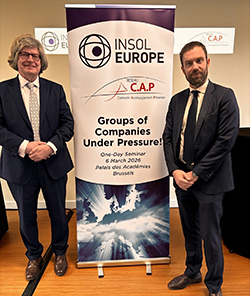
Our Council member Bart De Moor (Strelia, Belgium) and member Cédric Alter (Janson, Belgium) - who is also the president of Réseau Cap (association representing French speaking professionals involved in restructuring) with whom INSOL Europe has a cooperation agreement - pictured above - welcomed warmly the delegates. The INSOL Europe Immediate Past President Alice van der Schee presented our association and highlighted the importance of making restructuring and insolvency of groups of companies more practical and effective.
The keynote speech was delivered in person by Ondřej Vondráček, Legal and Policy Officer of the European Commission’s (EC) DG JUST Civil Unit. For the last decade, the EU’s legislative focus was on harmonising substantive restructuring and insolvency laws (e.g., Directive on Restructuring and Insolvency of 2019) before tackling jurisdiction rules. A new Directive harmonising certain aspects of insolvency is nearing final adoption. The focus will shift back to private international law, with a major report on the European Insolvency Regulation (EIR) planned for 2027 to guide future work on groups. The EC is open to new ideas for this review and is actively reading academic and professional publications for inspiration. A new, optional “28th regime” (an EU corporate law framework) will be proposed, but it will not include a comprehensive EU insolvency code.
A first panel session titled “When Group Structures Are Put to the Test” was led by Cédric Alter and featured panellists Christel Dumont (Dentons, Luxembourg) and Sid Pepels (Jones Day, the Netherlands). Sid Pepels outlined the fundamental tension in corporate groups: legal separateness for risk management versus economic interdependence. He highlighted the Dutch “WHOA” law, a private proceeding outside the EU Insolvency Regulation that allows a single entity to restructure debt for an entire group. Providing a perspective from Luxembourg, Christel Dumont discussed the risks of financial integration through cross-guarantees and contrasts Luxembourg’s strict approach to reorganisation proceedings with the more flexible Dutch model. Cédric Alter focused on the legal risks of cash pooling, citing a recent Belgian court case holding directors personally liable for prioritising group interests over an individual company’s survival.
Bart De Moor, chairing the second panel, introduced the concept of the “Anatomy of Groups of Companies.” He argued that groups are formed to fragment risk while maintaining central control, and this structure dictates director liabilities, especially as the definition of “corporate interest” shifts during insolvency to prioritise the entity’s survival. The panellist Isabelle Vincent (Simmons & Simmons, France) explained the paradoxical legal status of corporate groups in French law, which lacks a unified definition. She detailed risks like the extension of insolvency proceedings to the entire group, co-employment liability, and director liability, noting that French courts are becoming more pragmatic. The panellist Gregory Minne (Arendt, Luxembourg) explained the “double Luxco” structure, a sophisticated mechanism using two Luxembourg holding companies to create a robust share pledge that remains enforceable even if the debtor enters insolvency proceedings in another EU jurisdiction with a stay on enforcement.
The third panel questioned “Groups as a Unit: Myth or Reality?” and featured Ivan Verougstraete (Supreme Court, Belgium), Will Gunston (Osborne Clarke, UK) and Michael Thierhoff (Forvis Mazars, Germany). From the English law perspective, corporate groups are legally comprised of separate entities, yet regulators and tax regimes sometimes treat them collectively. Liability can reach parents through narrow veil-piercing (evasion), tort duties, and insolvency doctrines (wrongful trading, shadow directorship, preferences, transactions at undervalue). Group insolvency practice varies; England emphasizes single-entity procedures with coordinated appointments. Germany allows procedural consolidation under one court/administrator but rejects substantive consolidation. Belgium highlights judicial pragmatism and occasionally integrates assets/debts in exceptional cases and supports contractual multi-debtor arrangements.
The last panel focused on “One Group, Multiple Proceedings: From Fragmentation to Coordination” with Sid Pepels (Jones Day, Netherlands) and Alexandra Szekely (Le 16 Law, France). Cross-border cooperation under the EU Insolvency Regulation (EIR) mandates practitioner cooperation, but undefined efficiency standards, exceptions, and weak enforcement hinder practice. Protocols can coordinate asset sales (Nortel) but often fail on distribution; proposals include reframing coordinators as service providers, exploring coordinated appointments, and extending synthetic secondary proceedings to groups, while guarding against COMI manipulation and forum shopping.
The day was concluded with an exclusive guided tour of the Palais de Justice by Bart De Moor, offering participants a rare behind-the-scenes insight into one of Brussels’ most distinguished judicial landmarks.
|
|
| UNCITRAL Working Group V Report |
|
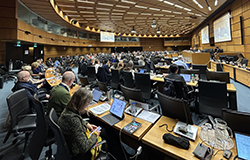
The sixty-seventh session of UNCITRAL Working Group V (Insolvency Law) was held in Vienna from 8 to 10 December 2025, with INSOL Europe participating as an observer. INSOL Europe Council Member Florian Bruder (DLA Piper) reports.
The session followed the completion of the project on asset tracing and recovery in insolvency proceedings and the adoption of the “toolbox” by the UNCITRAL Commission in July 2025.
|
 |
|
The Working Group continued its consideration of a draft model law on applicable law in insolvency proceedings and its accompanying draft guide to enactment, focusing in particular on the treatment of set-off, rights in rem, the interplay between insolvency proceedings and foreign litigation and arbitration.
The Working Group resumed consideration of the treatment of set-off under insolvency law. While some delegations preferred an alternative approach, the prevailing view favoured retaining the provision that set forth the application of the law of the State where the debtor had its COMI at the time of the claim giving rise to a set-off arose if deference to that law is necessary to protect the legitimate interests of the parties to the transaction. The Secretariat was requested to prepare additional drafting options along the lines suggested during the session. As to the appropriate level of judicial discretion regarding the application, delegations expressed divergent views.
The treatment of rights in rem generated extensive discussion as in the previous sessions. However, the Working Group now agreed that the provision should apply to all assets and consequently decided that the limitation to immovable property should be deleted. It was further agreed that an illustrative list might be included in the commentary and that enacting States could include domestic examples. Further, it was addressed that for assets not susceptible to localisation, the insolvency law of the State whose law governs the validity and effectiveness of the right in rem, as determined either by the private international law rules of the State in which the insolvency proceedings are commenced or by internationally accepted private international law rules.
The provision concerning the interplay between insolvency proceedings and foreign litigation and arbitration also proved difficult. Delegations expressed divergent views regarding the appropriateness and scope of automatic stays, the interaction with arbitration agreements, whether the provision should be framed as an applicable law rule, and the duration of any stay. Accordingly, it remains under consideration, with competing drafting approaches still on the table.
Following the session, UNCITRAL convened a colloquium on 11–12 December 2025 concerning possible updates to the Guide to Enactment and Interpretation of the Model Law on Cross-Border Insolvency which originally dates from 1997 and was revised in 2013. The colloquium served as a forum for discussion. While the colloquium showed the relevance of an update to the Guide, any such projects remain subject to further consideration by the Commission.
In summary, the sixty-seventh session marked substantial progress but at the same time core issues — particularly the treatment of rights in rem and foreign litigation and arbitration — remain under deliberation. From a European perspective, all issues discussed are directly relevant and should be explored further in the context of the review of the European Insolvency Regulation and the further development of the international insolvency laws of the EU Member States.
|
|
| Richard Turton Award 2026: Win a free place to the Vilamoura Congress! |
|

|
|
Richard Turton had a unique role in the formation and management of INSOL Europe,
INSOL International, the IPA (English Insolvency Practitioners Association) and R3 (Association of Business Recovery Professionals in the UK). In recognition of his achievements, these four organisations jointly created an award in memory of Richard.
The 2026 competition is now open for anyone who is a national of a developing or emerging nation; works in or studies insolvency and restructuring law and practice and is under 35 years of age. The successful applicant will be asked to write a paper of 3,000 words on a subject of insolvency or turnaround agreed with the panel. This paper will be published in summary in one or more of the four Member Associations' journals and in full on their websites.
The winner will be invited to attend the INSOL Europe Annual Congress in Vilamoura, Portugal, 14-18 October 2026, expenses paid. Applications deadline: 5 June 2026.
In the words of Dorjana Xhamaqi, winner in 2025: “The Richard Turton Award will always remain one of the moments that changed my path - a shining moment in my career - and also a promise I make to myself to continue working with passion, to never lose my sense of humanity and to never forget that a true professional is measured by the positive impact they leave behind.”
For more information and to apply, visit the Richard Turton Award page here.
|
|
| Save the Dates - Forthcoming Events for 2026 and 2027 |
|
The momentum is already building for this year's events. We’re shaping an exciting new programme of high-profile seminars and conferences, designed to bring businesses, industries, and professionals together to connect, collaborate, and unlock new opportunities.
The year ahead will be rich with moments for meaningful networking, influential thought leadership, and opportunities for strategic growth. Below is a preview of the key INSOL Europe events set to spark ideas, open doors, and help define the trends shaping 2026.
|

|
- 4 June 2026, R3 & INSOL Europe 20th International Restructuring Conference, London, UK
- 13 October 2026, YANIL Workshop, Vilamoura, Portugal
- 13-14 October 2026, Academic Forum Conference, Vilamoura, Portugal
- 15-18 October 2026, Annual Congress, Vilamoura, Portugal
- 17-19 June 2027, AIJA/INSOL Europe Young Members Group Joint Conference, Barcelona, Spain
Visit our website for more events to be added as they are confirmed.
|
|
|
|
Thanks to our General Sponsors
Please contact Hannah Denney for sponsorship opportunities.
We welcome feedback, news and story ideas for future newsletters.
Please send your suggestions to Paul Newson, email: paulnewson@insol-europe.org
Follow us on LinkedIn and join the conversation!
|
| INSOL Europe, PO Box 7149, Clifton, Nottingham. NG11 6WD |
| www.insol-europe.org |
| Unsubscribe from INSOL-Europe.org mailing. |
| Disclaimer: This newsletter is sent to members of INSOL Europe. No responsibility legal or otherwise is accepted by INSOL Europe for any errors, omissions or otherwise. The opinions expressed in the articles that appear are not necessarily shared by any representative of INSOL Europe. |
|
|
.jpg)