| Latest News from INSOL Europe. View this email in your browser. |
|

October 2025
|
|
|
Dear Members
Wow (rather than whoa!) – what an amazing Annual Congress in Vienna!
I am delighted and honoured to take over as INSOL Europe President from the wonderful Alice Van Der Schee and had a wonderful time at the 2025 conference. First, I must say a heartfelt thank you to Alice (and the Strategic Taskforce of course) for her hard work during 2024/2025, especially in the Strategic Taskforce, the results of which will secure the success and growth of INSOL Europe well into the future.
Secondly, for those not able to attend, as I said at the conference, whilst it may seem odd to have a UK President in a post-Brexit world, we in the UK are firmly committed to Europe and in our close partnerships with our friends in Europe. INSOL Europe plays an important part in insolvency with the EU and beyond and I am looking forward to leading delivery of the projects set by the Strategic Taskforce.
Thirdly, INSOL Europe needs you! We want input in this new phase of development from the wider membership so that we ensure that our organisation is collaborative with, and inclusive of, all our members. Please, if you wish to become involved in working groups, whether on membership, social media, academia or any other area, do just email me or the secretariat.
Finally, thank you to Paul, Hannah and Emma as well as Klaudia and Robert, for an amazing Vienna conference and to all our sponsors. Please look to the website for details of other events and particularly the Vilamoura Congress in October 2026.
Frances Coulson
President, INSOL Europe
|
|
|

Frances Coulson
President of
INSOL Europe
|
This issue is kindly
sponsored by:

DLA Piper is a global law
firm with lawyers located
in more than 40 countries
throughout the world.
www.dlapiper.com
|
|
| Vienna 2025: Lessons from the Past, Steps into the Future |
|
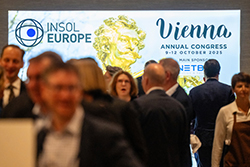
Two days, two keynotes on contemporary challenges, four breakouts on topical themes and seven plenary sessions on a range of diverse ideas on law and practice, added to which, there was a cast of eminent academics, judges and practitioners lending their views and expertise, plus 507 delegates from 35 jurisdictions.
The Vienna 2025 conference (generously sponsored by NetBid and many others) could be summarised in numbers.
|
|
|
But it was also a phenomenal gathering of insolvency and restructuring specialists in the surrounds of an artistic and cultural city of renown, themes that were echoed in some of the activities and sessions.
The business of running INSOL Europe also saw the various constituent meetings take place and key decisions made, while the baton was passed on to a new President for 2025-2026. Alongside this, delegates networked, enjoyed the conference material (including the problem-solving Workout Game), saw the sights, witnessed the musical and dramatic talents of members in the Grand Prix d’Harmonisation finale and danced at the Gala Evening. All in all, an energetic, exhausting, but stimulating event in Vienna, the city of Mozart, Strauss and Klimt.
A full report can be read here.
Photos from the event can be found on the Event Gallery page.
|
|
| When West meets East: Bridging Europe's Insolvency Regimes |
|
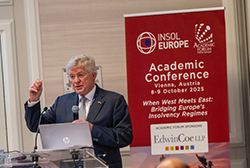
Generously sponsored by Edwin Coe LLP, the Academic Forum met in Vienna to bridge east and west with presentations devoted to the many rich facets of insolvency and restructuring.
Over 80 delegates attended, representing 23 different jurisdictions, illustrating the attraction of the programme that went beyond the confines of Europe and strayed across the globe.
|
|
|
Six key sessions, parallel breakouts, a Special Lecture, the Gabriel Moss QC Memorial Lecture and a joint session with the Judicial Wing (featured in the Edwin Coe Open Forum) were brought together in a programme that celebrated talent, skill and profound analysis of the issues of today.
Themes broached included the stigma of insolvency, the use and destination of insolvency assets, Artificial Intelligence and technology, stakeholder and community interests, arbitration and much more, all developed in presentations underpinned by academic rigour, but that also enabled the showcasing of new and emerging ideas, led by research and empirical studies. Across two days, punctuated by an Academic Dinner and numerous networking and discussion moments, the event was well-received and appreciated by those attending.
A full report can be read here.
Photos from the event can be found on the Event Gallery page.
|
|
| INSOL Europe Council Meeting and OGM |
|
|
|
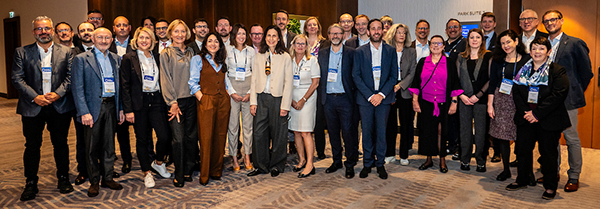
INSOL Europe's Council met in Vienna to discuss the past 12 months and goals for the forthcoming year, including the launch of our new Strategic Plan. Invited to the meeting for the first time were the new members who took their seats following the Council elections in September.
Angelina Bakker and Laurent le Pajolec have won the two non-reserved seats, replacing José Carles and Noor Zetteler (the latter having won the reserved seat for Netherlands, replacing Evert Verwey).
Bartosz Groele has won the Polish seat replacing Pawel Kuglarz. Andri Antoniou and Pekka Keloneva have won the two special non-reserved seats, replacing Jan Lilius and Frank Heemann (now he is Vice President). Also, Lukas Grill (Austria) will replace Matthias Prior, Preben Jakobsen (Denmark) will replace Michala Roepstorff, and Lukas Bopp (Switzerland) will replace Sabina Schellenberg.
At the OGM, Frances Coulson (UK) become the new President, with Frank Heemann (Lithuania) becoming the Deputy. We are also very happy to announce that Evert Verwey (Netherlands) has become the new Vice President, which means he will be the next President after Frank. We look forward to his valuable input into our meetings and discussions throughout the months to come.
We give wholehearted thanks to those Council members who have served their time and contributed so much to the work of our Association, and welcome on board those new members, whose input we look forward to in the following years.
A full list of all the Executive Officers and Council can be found on our website here.
|
|
|
10 Reasons to renew your Membership in 2025
- Get DISCOUNTED RATES for our flagship Annual Congress, Academic Conference, Eastern European Conference and joint events.
- Become part of our unique and RENOWNED COMMUNITY where you will have opportunities to network with over 1300 members from 50 countries.
- Access our MEMBERSHIP DIRECTORY where you can search for fellow members by name, jurisdiction, profession and expertise.
- Get in touch with your Council member and Country Co-ordinators to MAKE CONNECTIONS within your own country.
- Automatically become a member of INSOL International and get their full member benefits.
- Enjoy a free subscription to EUROFENIX, INSOL Europe’s popular quarterly 48-page journal.
- Free access to our huge TECHNICAL RESOURCES library.
- Opportunity to PUBLISH ARTICLES in Eurofenix, our Monthly newsletter, on our website and social media.
- GET INVOLVED on projects that affect your particular industry in one of our many working groups or committees.
- INSOL Europe has a STRONG RELATIONSHIP with EU officials and representatives of inter-governmental organisations.
|
Visit our website for more details or contact Hannah Denney.
|
| INSIDE Story: Bank Resolution Framework in Poland |
|
The topic of bankruptcy and bank resolution is currently being hotly debated in Poland, due to the high-profile bankruptcy proceedings of two large commercial banks – Idea Bank S.A. and Getin Noble Bank S.A., both in bankruptcy.
In both cases, solutions under EU law have previously been applied and provide, in this case, for solutions known from Directive 2014/59/EU – the so-called BRR Directive.
|

|
|
The manner in which these proceedings were conducted leads to the conclusion that the BRR Directive correctly and properly addressed the issues of interest. However, not all aspects have gone smoothly, as evidenced, for example, by the numerous consumer complaints about resolution in Poland. Read the full story here by Mateusz Kaliński and Paweł Kuglarz of Tatara and Partners, Poland.
|
|
| Update on National Insolvency Statistics from the UK |
|
On 18 July 2025, the Insolvency Service in England published its latest insolvency statistics for June 2025 on company insolvencies in England and Wales. The data illustrates that for June 2025, there were 322 compulsory liquidations, 1,585 creditors' voluntary liquidations, 111 administrations and 15 company voluntary arrangements. Summarised by Frances Coulson, Partner, Head of Insolvency & Restructuring, Wedlake Bell LLP (London, UK), Iand Boluwatife Amos-Alere, Insolvency and Restructuring Paralegal at Wedlake Bell LLP (London, UK).
|
 |
|
The Insolvency Service reported that the number of registered corporate insolvencies in England and Wales fell to their lowest level for the month of June since 2022. The year-on-year decline has been driven by a reduction in Creditors’ Voluntary Liquidations (“CVLs”) and Administrations, together with a slight fall in Company Voluntary Arrangements (“CVAs”). Whilst one month’s figures are not, in themselves, indicative of a sustained trend, they may suggest that some directors are delaying formal insolvency action, either in response to improved trading conditions or in the hope that the summer period will deliver a much-needed boost.
Compulsory Liquidations, however, have increased compared with June last year and remain significantly above pre-pandemic levels. This likely reflects a growing willingness among creditors to enforce debts via the courts, with HMRC continuing to take a more assertive stance in recovering sums owed to the public purse and having got their petitions for winding-up largely up to pre pandemic levels.
Although a fall in formal corporate insolvencies may be viewed as a positive development, wider economic sentiment remains subdued. Both businesses and households are exercising caution, with key operational and investment decisions being postponed amid ongoing uncertainty. GDP contracted for the second consecutive month in May, while unemployment has recently edged upwards, raising concerns as to whether this downward trend will persist. The latest UK unemployment figures for April to June 2025 show an unemployment rate of 4.7%, with 1.67 million people unemployed. This represents a 0.5 percentage point increase compared to the previous year. Estimates for payrolled employees in the UK fell by 149,000 (0.5%) between June 2024 and June 2025, and by 26,000 (0.1%) between May 2025 and June 2025.
Uncertainty over trade arrangements also continues to weigh on business confidence. The recent UK–US trade agreement has been welcomed by certain exporters but is not expected to have a transformative effect on the broader economy. In addition, speculation regarding potential tax rises in the autumn adds to the unease. For many business owners, the absence of clarity over further potential cost increases makes forward planning, recruitment, and investment decisions far more challenging. The recent increase in employers' national insurance ("NICs") has already placed a number of businesses under pressure. In the 2024 Autumn Budget, Chancellor Rachel Reeves announced the rate of employers' NICs would increase from 13.8% to 15%, from 6 April 2025. The level at which employers start paying NICs (the secondary threshold) has also been reduced from £9,100 to £5,000 per year.
This lack of confidence is evident across several sectors. In May, retail sales fell sharply as consumers cut back on non-essential expenditure. The hospitality industry has also experienced significant job losses — often a last resort for operators under financial strain — with the recent increases in the National Minimum Wage and NIC's further tightening margins and leading many businesses to leave vacancies unfilled. While some may be hoping for a strong summer season, it is far from certain that improved weather and footfall will be sufficient to offset these pressures.
The construction sector, too, has shown signs of strain, with small expectation of small growth. Output fell in May, with developers reporting reduced activity as house price growth levels off. Part of this slowdown reflects landlords exiting the market in response to legislative changes, with the introduction of the Building Safety Act 2022, but the wider issue lies in weakening demand and low confidence. In a buyer’s market, developers may be reluctant to build into declining prices, and for a sector that already operates on tight margins, such hesitancy can quickly translate into mounting financial pressure. There also remains some uncertainty around prices for goods and materials – which has been complicated further by geopolitical developments – and the industry continues to battle with the impact of labour and skills shortages. Despite these challenges, Government policy through the Infrastructure Strategy, promises significant investment into certain sectors. Although, it remains to be seen how quickly this will flow through the supply chain, and whether this will benefit certain geographical areas and sectors more than others.
UK economic growth slowed in the second quarter of the year to 0.3% albeit this was better than economists had forecast. It does however mark a slowdown from 0.7% growth in the first quarter. In the first quarter of the year there was a rise in exports and house sales before US tariffs and the 1st of April 2025 increase in stamp duty on property sales.
It is expected that the UK will keep to a what is comparatively reasonable growth path in a worldwide sluggish market. albeit as Liberal Democrat Treasury spokesperson Daisy Cooper said “snails would scoff at the pace that our economy is growing" and despite recent policy announcements, it is unlikely to be a smooth or fast ride to high growth and who knows when we might see again the steady economic growth the UK enjoyed between 1991 and the 2008 crash.
Read further updates from the UK and other jurisdictions on our website here.
|
|
| US & EU come to Berlin for the 21st ABI / INSOL Europe Symposium |
|
Whilst the weather in Berlin was dark and stormy, the atmosphere inside the venue for the 21st joint ABI & INSOL Europe seminar was warm and inviting. Professor Christoph Paulus toasted the delegates at the drinks reception on Sunday evening, encouraging delegates to experience the nearby visitor attractions during their visit, many of whom had come over from the US for the event. There were over 80 delegates in total.
|
|
|
Philipp Esser (Schultze & Braun, Germany) and Judge Bruce A Harwood (US, Retired) kicked off the first day and introduced the morning panels - a keynote interview with Morgan O'Neill (Sound Point Capital Management, LP, New York) followed by a panel led by John Willcock (Editor, Global Turnaround) focusing on the rise of private credit. The Automotive panel which followed discussed the First Brands case, a topic which was picked up several times during the day.
In the afternoon, INSOL Europe past-Presidents Frank Tschentscher (Deloitte Legal, Germany) and Barry Cahir (Beauchamps, Ireland) led much anticipated panels. Frank’s panel compared filing laws and requirements in key jurisdictions, including Ireland and Germany, and examined the evolving roles of independent directors and restructuring practitioners, with much discussion and debate amongst the panellists and audience members. Barry’s panel explored how tariffs, geopolitical tensions and macroeconomic pressures are reshaping the restructuring landscape, with uncertainty becoming the new norm, much to the chagrin of investors.
A full report will be published in the next edition of Eurofenix.
|
|
| Forthcoming Events: INSOL Europe / Reseau Cap Seminar, Brussels |

INSOL Europe and Réseau CAP are pleased to invite you to a one-day seminar on “Restructuring and Insolvency of Groups of Companies”, taking place in Brussels on Friday, 28 November 2025, at the stunning neoclassical Palais de Académies in Brussels.
The event will bring together leading practitioners, academics, and policy-makers to explore the challenges and opportunities of cross-border group restructurings and insolvencies.
.jpg) Keynote Speaker Keynote Speaker
We are please to announce that our keynote address will be made by Mr. Ondřej Vondráček, Legal and Policy Officer, European Commission, who will provide his personal insight on current EU Commission initiatives on group insolvencies.
Technical Programme
This will be followed by expert panels on topics including intercompany claims, cash pooling, directors’ responsibilities, D&O insurance, the treatment of groups as single organisations, and cooperation between practitioners across jurisdictions.
Guided Tour
The day will close with a guided tour of the Brussels Courthouse, one of the city’s most iconic architectural landmarks.
Further details and registration is now open here.
|
|
|
Thanks to our General Sponsors
Please contact Hannah Denney for sponsorship opportunities.
We welcome feedback, news and story ideas for future newsletters.
Please send your suggestions to Paul Newson, email: paulnewson@insol-europe.org
Follow us on LinkedIn and join the conversation!
|
| INSOL Europe, PO Box 7149, Clifton, Nottingham. NG11 6WD |
| www.insol-europe.org |
| Unsubscribe from INSOL-Europe.org mailing. |
| Disclaimer: This newsletter is sent to members of INSOL Europe. No responsibility legal or otherwise is accepted by INSOL Europe for any errors, omissions or otherwise. The opinions expressed in the articles that appear are not necessarily shared by any representative of INSOL Europe. |
|
|
.jpg)