


Keep up to date with Insol Europe news on our LinkedIn profile page...
News from INSOL Europe

19 March 2020
As you are aware, the situation regarding the new Coronavirus is changing on an almost daily basis. INSOL Europe has been closely monitoring developments of the impact of COVID-19 at local and global levels. The health and well-being of the INSOL Europe community are our priority.Following advice provided by the World Health Organization (WHO) and European governments, many of our forthcoming events are now affected.
- The joint conference in Zagreb, planned for 27-28 March, has now been postponed indefinitely.
- The joint conference with INSOLAD on 11 June in Amsterdam has now been postponed.
- The joint conference with R3, planned for 2 July in London, has now been cancelled.
- The Eastern European Countries Committee Conference, Kyiv, Ukraine, on 21-22 May is now postponed until the Autumn.
Please note that our Annual Congress in Sorrento, Italy, 1-4 Ocober 2020 is still going ahead as planned at the moment.
For any additional information, please contact Harriet Taylor.
Our thoughts are with our colleagues around the world impacted by COVID-19.
27 January 2020
The 54th session of Working Group V began in Vienna with the nomination of a new Chair, Harold Foo from Singapore. The objective of the session was to consider the problem of insolvency in relation to Micro- and Small-Enterprises (MSEs). Delegates to Working Group I on business law rules joined the insolvency experts in the room for four days of deliberations. The aim was to provide a model law to help govern the position of enterprises that constitute, in many developing and developed countries, 90-95% of all businesses operating in the economy. Recommendations on the principle of a simplified insolvency regime and its treatment of all business debts were readily adopted at the end of the four days’ work, though not without a great deal of scrutiny of the proposals. Overall, the right balance was sought between the UNCITRAL Legislative Guide framework and the simplified version that was to be recommended for adoption by UN member states.A great number of issues arose that required a resolution through the consensus model that UNCITRAL operates. Delegates were asked to determine, inter alia, whether a debt repayment plan as a condition for discharge should be an adjunct to or an outcome of simplified proceedings and whether the overall framework should refer to “competent authorities” or just “courts”, with a view to being as embracing as possible with respect to the oversight authority for such proceedings. Other issues canvassed included whether there should be a cap on the number of times proceedings can be extended or instigated, avoiding the possibility of “repeat offenders”, whether the principle of a “discharge” should be framed negatively or positively, by being attainable at a reduced cost and with limited formalities (as the World Bank Principles also foresee) and whether, in particular, secured creditors should be immune from any stay provided in such proceedings.
In addition, concerns were raised over what information should debtors have to provide for proceedings to begin or continue and whether the opening of proceedings could be “automatic” on filing or needs to be subject to control by a competent authority. Whether clawback rules needed to be expressly mentioned was also a theme debated in the group. The context for these issues, in particular, was how to avoid fraudulent filings and how to prevent abuse of process. Lastly, touching on the situation of No Income No Asset cases, delegates were of the view that guidance had to be given as to what elements of a simplified regime would be appropriate for these problematic, but increasingly prevalent cases. As such, a number of delegations volunteered to provide technical assistance should any UN member states require help in transposing one or more of the series of Model Laws that have resulted from UNCITRAL’s work since 1997.
Report by: Florian Bruder, DLA Piper Munich and Paul Omar, Technical Research Coordinator, INSOL Europe.
17 January 2020
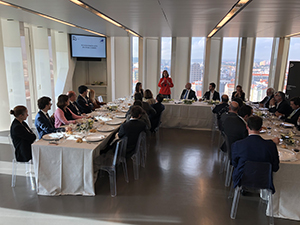 Portugal is one of the European countries with the lowest level of representation in INSOL Europe with currently only 24 members. Accordingly, with the main objective of boosting INSOL Europe’s activity in Portugal, Alberto Núñez-Lagos, partner of Uría Menendez, organised the first of a series of meetings that took place during last year. This group has grown in the meantime and it now includes some of Portugal’s leading insolvency professionals. Among them are judges, consultants, insolvency administrators and lawyers. This group has held regular meetings in the offices of the most renowned law firms in Portugal.
 On 17 January, Nuno Líbano Monteiro (partner and head of the Insolvency and Restructuring team at PLMJ, the largest law firm in Portugal) and Catarina Guedes de Carvalho (a PLMJ managing associate), both members of INSOL Europe, organised a meeting at their offices in Lisbon, which brought together 30 people, including lawyers from the leading law firms, partners from Deloitte and KPMG, and a number of top insolvency administrators.
The speakers were João Rodrigo Santos, CEO of Athena Equity Partners and Prof. Catarina Serra, a well-recognised academic the area of insolvency, judge of the Supreme Court of Justice and also a recognised member of INSOL Europe, in the Judicial and Academic Forum, and also co-editor of Eurofenix.
On the agenda was a discussion of the role of venture capital funds in the restructuring of companies and the implementation of Directive (EU) 2019/1023, on preventive restructuring frameworks and on discharge of debt and disqualifications. A decision was also taken to make a commitment to the INSOL Europe group working actively to get the legislature to implement this Directive in Portugal.
This group is planning to organise further initiatives to bring greater dynamism to the activities of INSOL Europe in Portugal.
02 December 2019
Over 60 delegates from the financial and banking services sector met in London on the evening of 2ndDecember for the third joint INSOL International and INSOL Europe Financiers’ Group Panel session and reception.The meeting was hosted by NatWest at their London offices and opened by Sean Pilcher, Fellow, INSOL International, NatWest. Alastair Beveridge, immediate past-President of INSOL Europe and member of the INSOL Executive Committee welcomed the delegates and introduced the panel.
Chaired by Raquel Agnello QC (Erskine Chambers), the panel of top UK industry experts – Simon Baskerville, Latham & Watkins; David Beckett, SC Lowy; Martin Gudgeon, PJT Partners and Nick Ram, Lloyds Banking Group – started the discussion observing that the credit market have seen an increasing complexity of capital structures and new classes of lenders and investors.
The panel reminded the audience that traditionally, companies were funded by loans from traditional banks. Only large, well-established corporations had access to the public debt markets. Corporate loans were syndicated to a limited number of commercial banks that held the debt until final maturity. The banks would monitor the borrower more intensively and the borrower would have had to negotiate with a limited number of banks in the event of stress.
The rise of loan trading and the number of non-bank institutions in the credit markets made this approach obsolete. Loan trading has made restructuring processes more complex as the number of debt holders has increased and alternative investors can have a more aggressive negotiating stance than traditional banks. Loan trading has the potential to increase lender conflicts during negotiations as the incentives of par lenders are not the same as those of secondary market participants – a restructuring proposal may be acceptable to a lender that bought into the debt at below par, but unacceptable to a primary lender that provided the original loan at par.
The panel explained that in recent years the UK has seen innovative financing structures, such asthe credit default swap (CDS) market, in which new stakeholders have created a changing dynamic in restructuring. CDSs are derivatives that behave like insurance contracts, protecting holders against the risk that a company does not repay its debts. The credit default swap market has created a whole new category of investors that stand to make more money on CDSs if a company defaults than they would if it repaid its debts. Other stakeholders, such as regulators, landlords and pension trustees, are becoming increasingly sophisticated and activist in their approach. The panel discussed the impact of these stakeholders on restructuring in an ever more dynamic and evolving market.
After an hour or so of lively debate the session was brought to a close by Piya Mukherjee, current President of INSOL Europe, with the conclusion that financial restructurings in the UK are inherently complex and more challenging and a request for more people to get involved with the Financiers Group in order to enable this kind of forum to continue. Delegates enjoyed light canapés after the event and spent some time networking before dispersing into the City.